By Amy Wimmer Schwarb
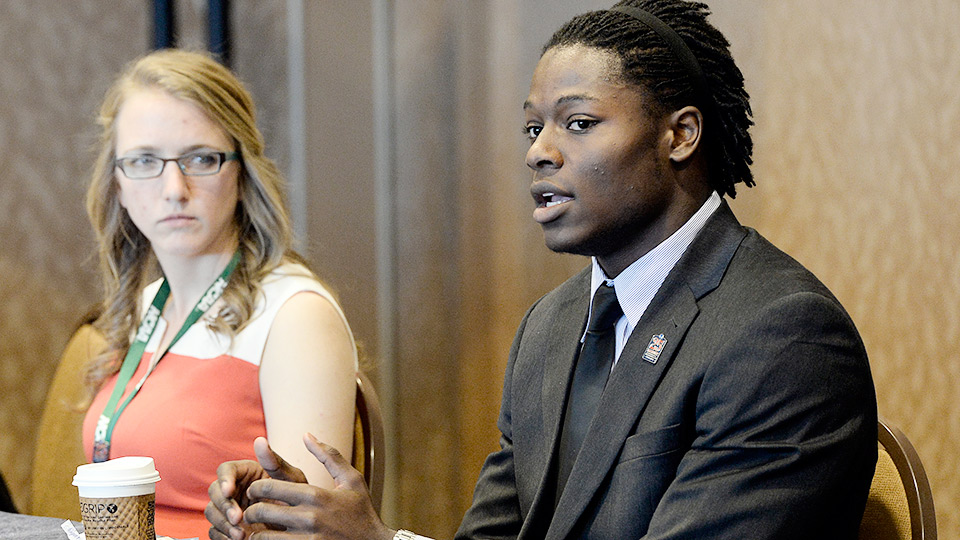
University of Georgia football student-athlete Chris Conley speaks during Wednesday’s Division I SAAC meeting at the 2014 NCAA Convention.
The NCAA Division I Legislative Council on Wednesday reached consensus on some key proposals, from loosening recruiting rules to requiring member schools to designate a team physician and report catastrophic injuries to the Association. But the council members also agreed that some pieces of legislation need more clarity and input from membership.
“We had a healthy discussion, and some points that were raised were valid,” said Mary Mulvenna, chair of the Legislative Council and assistant commissioner for compliance for the America East Conference. “There were several questions raised that will help us get where we need to be.”
The council, meeting as part of the 2014 NCAA Convention in San Diego, agreed to require Division I schools to report annually to the NCAA all fatalities, near-fatalities and catastrophic injuries incurred by student-athletes. Another proposal approved Wednesday, also related to student-athlete health and well-being and put forward by the Committee on Competitive Safeguards and Medical Aspects of Sports, requires member schools to designate a medical doctor or osteopathic physician to serve as team physician for each of their intercollegiate teams.
“When you look at why we’re in this business, it is because of the student-athlete,” Mulvenna said. “So we’re glad to accomplish some things that benefit them.”
The Legislative Council also adopted new rules allowing recruiting communication to start Sept. 1 of a recruit’s junior year, except in basketball, football, men’s ice hockey, swimming and diving, cross country and track and field. Off-campus recruiting dates would not change for any sport. The proposal also eases restrictions on the frequency and forms of communication and allows, for instance, text messaging.
In addition, men’s ice hockey coaches will now be allowed to begin recruiting communication on Jan. 1 of a recruit’s sophomore year and have off-campus contact with a recruit beginning June 15 following completion of their sophomore year.
The Legislative Council also defined what a member school must consider a “countable coach,” a move intended to help ensure fair competition, and approved the women’s triathlon as an emerging sport. The council tabled a proposal requiring all strength and conditioning coaches to be certified through a nationally recognized certification program.
But the panel elected to return a number of other proposals, including some that have received much public attention, to the membership for more input. Those pieces of legislation include:
-
Long-debated legislation that would allow Division I schools to provide more meals to student-athletes. The council considered two different plans: one that would allow institutions to provide unlimited meals to student-athletes, and one that was more restrictive, allowing meals “incidental to participation.”
Council members agreed additional time would provide the opportunity to help clarify how to apply the new rules. -
A proposal that would have reduced the penalty for student-athletes who test positive for using “street drugs.” The legislation would make the penalty for using those drugs lighter than the penalty for performance-enhancing drugs.
The Legislative Council was reluctant to liberalize its stance on “street drugs” or treat them differently than performance-enhancing drugs, even though only the use of the latter typically is considered a form of cheating. -
The Legislative Council also decided to seek more membership comment about a proposal to require all coaches, including strength and conditioning coaches, to be certified in first aid, CPR and defibrillator use.
The adopted proposals are not considered final until the close of the Division I Board of Directors meeting Saturday.